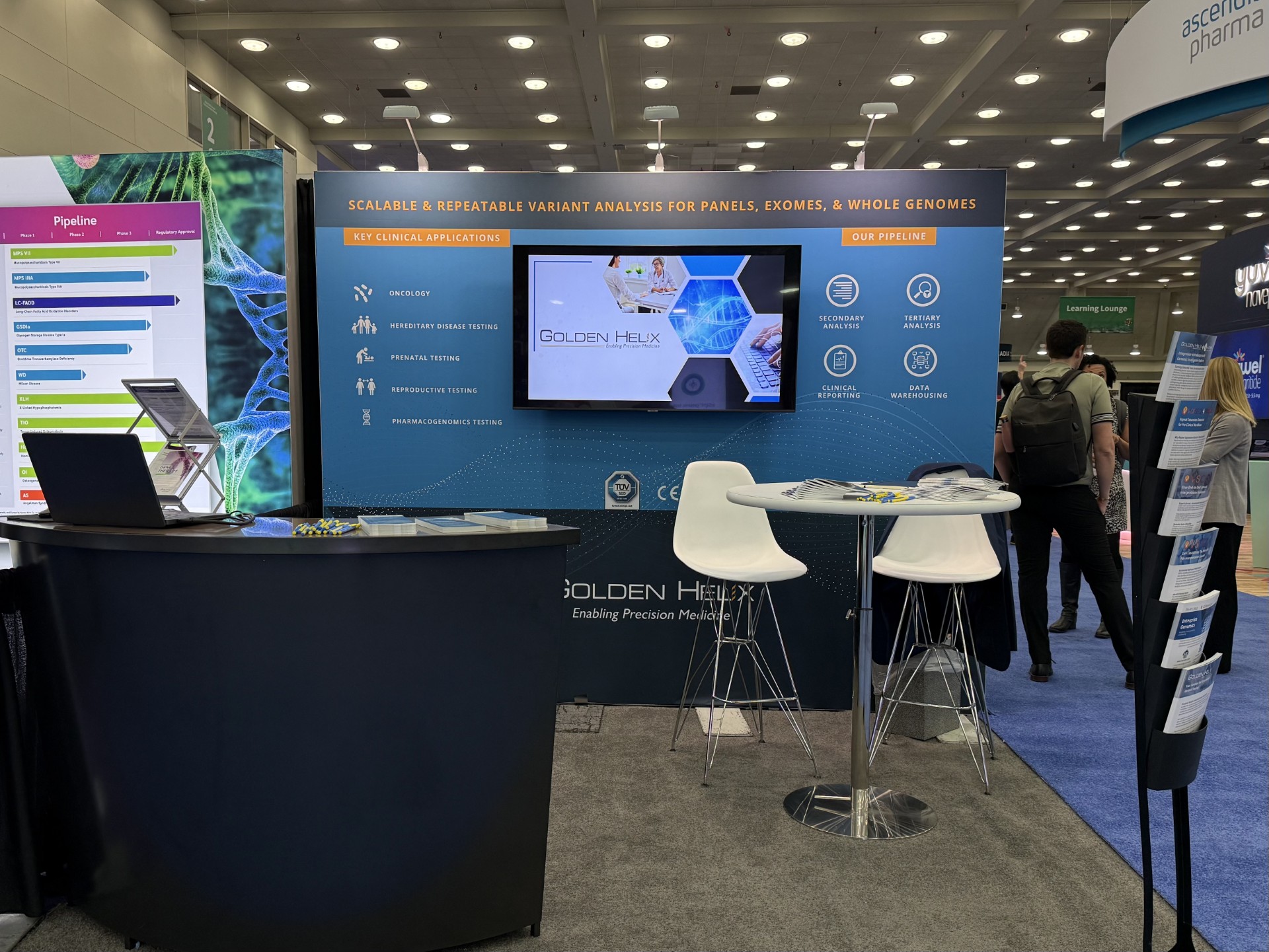
This month, members of the Golden Helix team traveled to Baltimore, Maryland, for the 2026 Annual Clinical Genetics Meeting (ACMG). We had such a great time talking to everyone who stopped by our booth to chat, watch our demos, or pick up a t-shirt.
Across those conversations, one theme kept coming up: labs want a platform that can scale with them, simplify operations, and support the full range of modern clinical testing. We presented demos of our enterprise platform, VSWarehouse – a multi-user platform consolidating secondary and tertiary analysis, whether labs are working with panels, exomes, or whole genomes from short-read or long-read data.
Enhanced Cloud Deployment Flexibility
Cloud deployment was one of the clearest themes we heard at ACMG. With VSWarehouse as the central engine for the VarSeq Suite, labs can deploy in their own AWS or Azure environment and run high-throughput clinical pipelines with the scalability of the cloud while maintaining full data sovereignty. That bring-your-own-cloud approach gives teams a practical middle ground: the flexibility to scale compute when needed, the ability to avoid overbuilding local infrastructure, and the confidence of keeping their data and workflow environment under their own control. We have also made that path much easier by streamlining the setup process, so labs can adopt cloud infrastructure faster and with less operational overhead. Just as importantly, we continue to fully support on-premises deployment, giving labs the freedom to choose the model that best fits their technical, operational, and regulatory needs.
Expanded Long-Read Support Across Secondary and Tertiary Analysis
Long-read support was one of the most exciting topics we discussed at ACMG. As more labs evaluate PacBio and Oxford Nanopore for clinically relevant use cases, they are looking for ways to support both secondary and tertiary analysis without fragmenting their workflow stack. With VSWarehouse and VarSeq, we are expanding long-read support across the workflow, including PureTarget targeted long-read applications and downstream CNV, structural variant, phasing, and interpretation capabilities in VarSeq. That means labs can bring short-read and long-read data into the same high-throughput clinical environment, rather than managing disconnected tools for different sequencing modalities.
Flexible Pricing Models for Labs at Different Stages of Growth
Another strong theme at ACMG was accessibility. Not every lab wants to start with an unlimited site license, especially when sample volume is still growing or varies month to month. That is why our flexible, token-based pricing models resonated with so many teams. For most labs, programs, and groups with variable throughput, sample-based pricing can be a real advantage: it aligns cost more directly with actual usage while still providing access to enterprise-grade capabilities. At the same time, larger institutions – especially those with multiple labs or departments – that need broad, predictable use at scale can still choose an unlimited site license. So, whether you’re running a focused diagnostic lab or managing a national-level genome program, we can tailor a licensing model to meet your needs—today and as you grow.