
Variant interpretation is an iterative process, and over time, labs can accumulate a large collection of reviewed variants. Managing these interpretations efficiently is critical for saving time, reducing redundancy, and maintaining consistency across projects. VarSeq assessment catalogs serve as a central repository for storing variant classifications, interpretations, and supporting details. They capture key information such as:
- Variant information (e.g., chromosome position, Ref/Alt alleles, identifiers)
- Classification (Pathogenic, Oncogenic, etc.)
- Interpretation summary (the evidence supporting classification)
- Author and date of assessment
- Schema-specific details (such as disorder or clinical notes)
These catalogs make it possible to automatically fill in prior interpretations when a variant is seen again in another sample, reducing the need to duplicate work.
What’s New in VarSeq Warehouse 3.0
VarSeq assessment catalogs typically work in the background, ensuring reviewed variants are stored and available for reuse. With VarSeq Warehouse 3.0, we’ll make this process far more accessible:
Users will now search and retrieve any stored variant directly from the VarSeq GUI. This means users no longer need to wait until a variant appears in their current project to see if it has been previously interpreted. Instead, you can:
- Search across catalogs for any stored variant, regardless of project.
- Instantly retrieve stored interpretations and supporting details.
- Easily review information saved by colleagues when working in shared team catalogs.
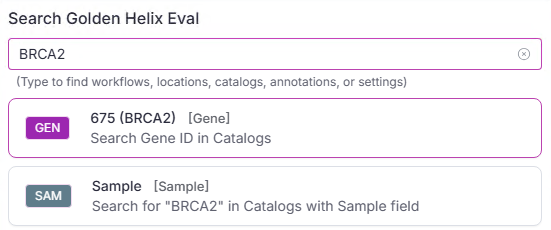
This enhancement gives labs full visibility into their knowledge base of variant assessments and makes reusing prior work as simple as a quick search. This ability to search and retrieve stored interpretations saves time by eliminating duplicate effort when reclassifying variants, promotes consistency by ensuring the same classification and reasoning are applied across projects, improves collaboration since teams can easily see who authored an interpretation and when it was created, enhances transparency with stored notes and schema-specific details providing relevant context and most importantly, by bringing catalog search directly into the VarSeq GUI, we’ve removed friction from the interpretation workflow and made your stored knowledge more accessible and actionable.
If you are ready to explore the new search and retrieval capabilities of assessment catalogs in VarSeq Warehouse 3.0, we would love to hear from you. Please direct any questions about creating or using assessment catalogs to [email protected].
.
