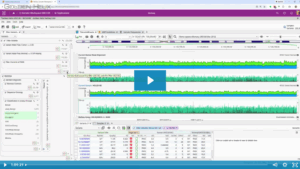
Native Support for Sentieon

In Part 1, we focused on what it means for VSWarehouse 3 (VSW3) to have native support for WDL. This time, we are focusing on built-in workflows for long-read alignment and variant-calling using Sentieon, which can help reduce secondary analysis compute cost and turnaround time.
Long-read datasets are information-dense, but they are also large. Even when the long-read chemistry is excellent, the lab still has to align reads, call small variants, and generate the files needed for downstream analysis. If that work is slow, expensive, or nondeterministic, everything downstream inherits those limitations.
That is one reason VSW3 includes built-in Sentieon workflows for short-read and long-read.
Sentieon support for long-read alignment and variant calling
Most discussions of Sentieon start with short-read pipelines, and for good reason. Sentieon’s DNASeq workflow is widely used as a faster, more accurate implementation of alignment and variant calling models that many labs already trust. That efficiency brings down costs when workflows are scaled across compute infrastructure.
Long-read is where the practical value can be even more obvious. In long-read whole-genome sequencing, alignment and variant calling are often the main drivers of how quickly a sample becomes usable for downstream interpretation. Sentieon’s DNAscope LongRead accepts PacBio HiFi and Oxford Nanopore reads and uses pretrained models tuned for those platforms to accelerate analysis.
That speed enables a “best of both” pipeline where you can use Sentieon for fast alignment and variant calling, then use other tools for specialized long-read modules. The point is not that there is only one best pipeline. The point is that VSW3 makes it practical to package best-practice components into cohesive, configurable automation.
Sentieon as a built-in GUI workflow
In VSW3, users get the ease of launching and reviewing secondary workflows visually, while still retaining a clear record of which task definitions, parameters, references, and inputs produced the final VCF.
VSW3 maintains a workflow history that makes reproducibility the default. When you rerun a sample six months later, you can still answer questions like:
- What version of Sentieon ran?
- What reference and model files were used?
- What parameters were passed to alignment and calling?
- Where are the logs, QC files, and intermediate artifacts?
- Which upstream inputs produced this VCF?
A clean handoff to tertiary analysis
Secondary analysis only creates value when it reliably feeds the next step.
In our platform, that next step is tertiary analysis: interpretation and reporting workflows in VarSeq, along with downstream assets like catalogs that can be reused across projects. When Sentieon runs as a Warehouse task, the resulting VCFs, BAMs, metrics, and logs land where downstream automation expects them to be.
That makes it straightforward to connect Sentieon germline calling outputs into VarSeq germline project templates, or to connect Sentieon tumor-normal calling outputs via TNscope into VarSeq somatic pipelines.
Fast, reliable secondary analysis with configurable automation
Using Sentieon for long-read alignment and variant calling can reduce turnaround time, reduce compute, and make it realistic to scale long-read programs. In VSWarehouse, this is delivered through a convenient GUI for running and reviewing workflows, while still allowing teams to customize the underlying workflow logic.
In VSW3, you can combine:
- A fast, deterministic secondary analysis core with Sentieon
- Long-read best-practice modules for SVs (structural variants), repeats, phasing, and other specialized outputs
- A workflow platform that tracks versions, parameters, inputs, outputs, and logs
- The ability to customize each step of the process