Thank you to everyone who joined our webcast, “AI as Infrastructure for Clinical Genomics: Reducing Routine Work, Preserving Expert Judgment.” We explored a practical question for clinical laboratories: as tests move from panels to exomes and genomes, how can we reduce the time spent gathering evidence and writing interpretations without turning clinical judgment over to a black box?
Put AI where the evidence already lives
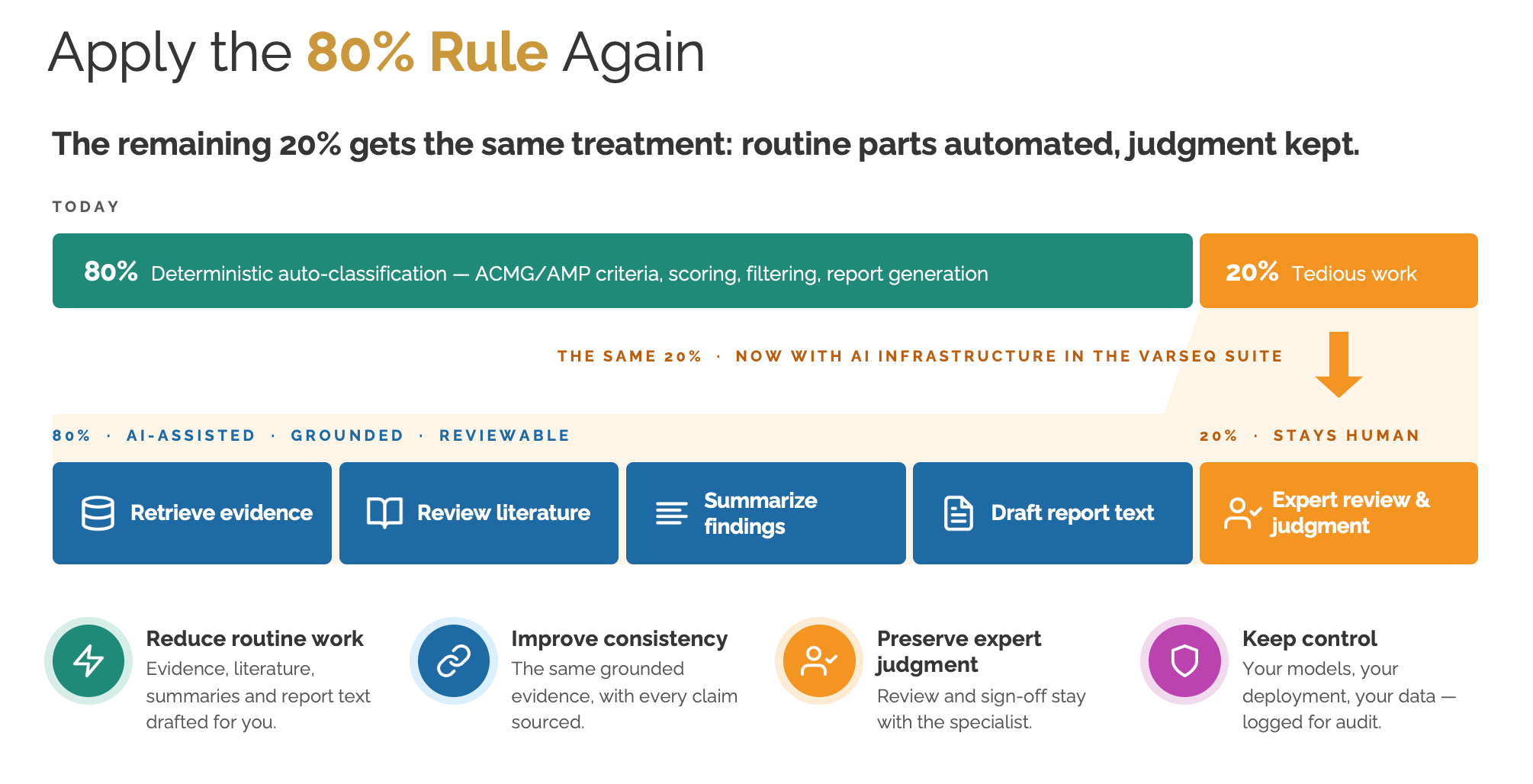
VarSeq already does a great deal of deterministic work: annotating variants, filtering candidates, applying ACMG criteria, and organizing the evidence a reviewer needs. The remaining work often involves finding and reading relevant papers, reconciling conflicting evidence, and turning a detailed evaluation into concise, consistent report language.
Rather than asking a general chatbot about a variant with no context, we showed how the VarSeq AI assistant starts with the lab’s actual annotations, auto-classifier results, selected criteria, and linked literature. Managed prompts can then follow the lab’s own interpretation style. The resulting text and evidence return to the familiar review workflow, where an expert can inspect, change, and approve them.
What we demonstrated
In a rare-disease trio analysis, we used AI to shorten an auto-generated interpretation and translate technical text into German without leaving VarSeq. We then ran a broader evaluation that retrieved literature, reviewed clinical and functional evidence, reconsidered ACMG criteria, and drafted an interpretation for review.
One example showed why this matters: a variant’s high population frequency initially supported benign evidence, but literature supplied important disease and population context. The assistant proposed revisiting those criteria and the resulting classification. This new classification and supporting evidence is drafting right in VSClinical, bringing relevant evidence to the reviewer sooner, with the reviewer making the final call.
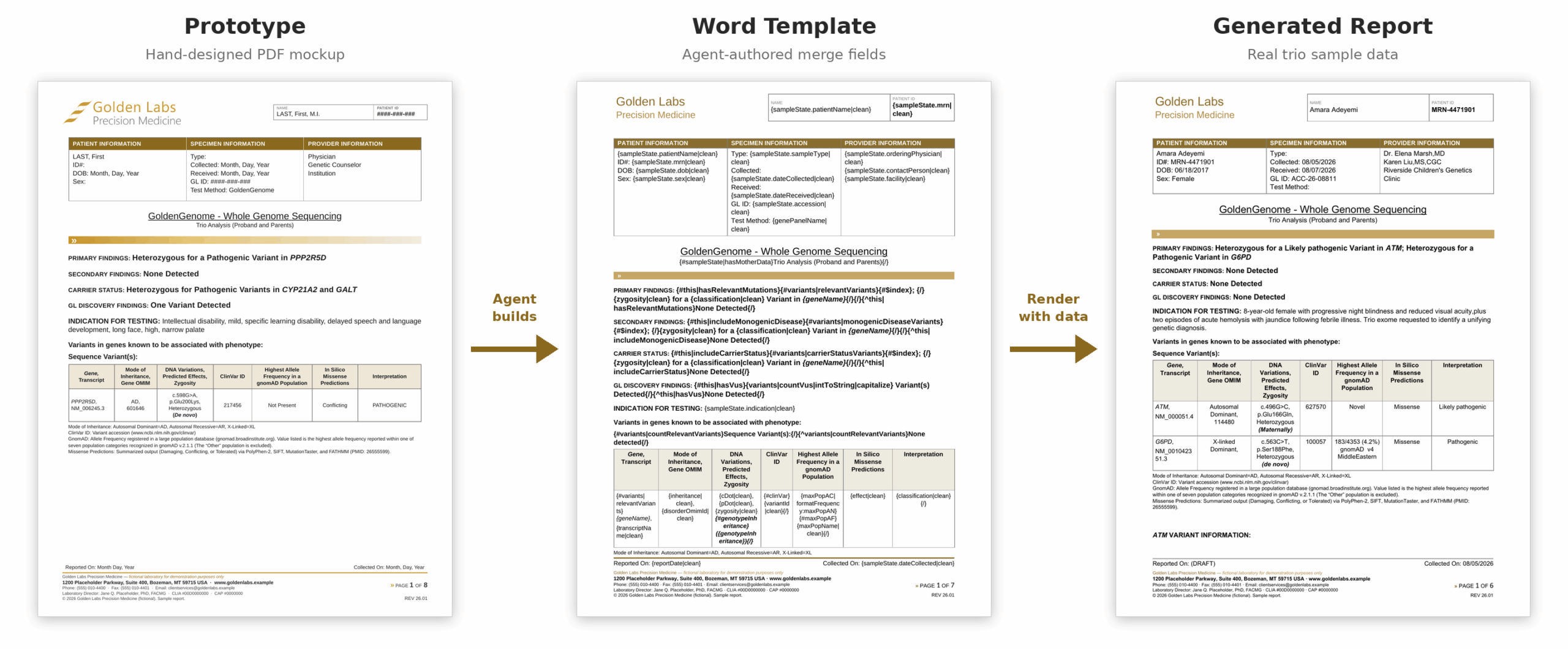
We also demonstrated an agentic workflow on the server: starting with a PDF mockup of a clinical report, it iteratively generated a Word-based VarSeq report template and rendered it against the example case. It illustrated how the same infrastructure can help with setting up and configuring new clinical tests as well as variant interpretation.
Behind these examples is an AI gateway in the lab’s own VSWarehouse environment. Teams choose their model provider, manage API keys and prompts, set access and usage policies, and review logs. Depending on their requirements, they can use a direct AI provider, a cloud-hosted model, or a locally hosted model. A lab can make a choice if and how data leaves their environment, retaining compliance while accessing frontier models.
Questions from the webcast
How do you avoid fabricated PubMed citations?
We do not ask a model to invent a reading list from memory. VarSeq retrieves real references already linked through sources such as ClinVar, LitVar, Mastermind, and OMIM, then supplies those citations and available article information as context. The assistant can help sort and summarize the material, but the references and their relevance still need expert review.
Can a reviewer upgrade or downgrade an ACMG classification when new evidence is found?
Yes. The reviewer can change the applicable criteria based on additional evidence, and the classification updates accordingly. The population-frequency example in the demo showed why a deterministic starting point and a literature-informed review belong together.
Do you support open-source models or models running on local computers?
Yes. Open-source models can be accessed through a cloud provider or hosted on your own compute, including on-premises hardware. We have set up a Dell Pro Max with GB10 running an open-source model and found it capable of useful baseline work. Other local options are available; the right choice depends on your performance, privacy, and infrastructure requirements.
Can I use my personal Claude subscription or Claude Code with VarSeq?
The built-in AI gateway connects to services using API-key authentication, so a personal chat subscription generally cannot be used to power that gateway. There is another route: Claude Code or Codex, signed in through your own subscription, can work in agentic mode against the server’s documented APIs to automate the same kinds of tasks and iterate on a problem. We also have a platform app designed to run those agent loops in a controlled environment, with the context needed to work with the server’s various capabilities.
Where to go from here
Our goal is not to remove the expert from clinical genomics. It is to give that expert a better starting point: relevant evidence already assembled, routine writing reduced, and the path from input to proposed output available for review. If you would like to evaluate these workflows with your own data, reporting requirements, and deployment policies, contact our team. You can also watch the webcast recording.
