
Thank you to everyone who joined our webcast, “What’s New in the Golden Helix Annotation Library.” During the webcast, we explored the annotation sources that support rare disease, cancer, and pharmacogenomics workflows, discussed the curation and quality assurance required to keep them current, and highlighted new sources and capabilities introduced in 2026. We also demonstrated how VSWarehouse brings versioning, review, and consistency to a laboratory’s own gene preferences and gene lists.
Annotations: The Evidence Behind Variant Analysis
Every stage of variant analysis depends on specific sources of evidence. Filtering draws on population frequencies, transcript models, and gene panels. Interpretation uses clinical assertions from ClinVar and ClinGen, gene-disease associations, and published literature. Reporting brings these findings together with information about functional studies, therapies, clinical trials, and other clinically relevant evidence.
AI-assisted interpretation adds another dimension to this workflow. Reliable results depend on the quality and traceability of the underlying evidence, including the sources a model uses to support its conclusions.
The annotation sources provided by the Golden Helix Annotation Library comprehensively cover the evidence domains used in rare disease, cancer, and pharmacogenomics workflows, with regular updates ensuring that all annotations keep pace with upstream data releases and new clinical knowledge.
The Annotation Library by the Numbers
Golden Helix maintains 268 annotation series, comprising 207 public and 61 licensed series, across GRCh37, GRCh38, and T2T. Over the past 12 months, 66 series were updated, with release schedules ranging from monthly to quarterly depending on the source and eight new series have been added in 2026.
The library is organized around three major diagnostic areas:
- Rare and inherited disease: Resources include ClinVar, ClinGen expert curation and dosage sensitivity, OMIM, LitVar2, Genomenon Mastermind, gnomAD, functional and splice predictors, and PanelApp gene panels from Genomics England and Australian Genomics. Together, these sources support variant prioritization, clinical interpretation, and classification.
- Cancer: The library includes Golden Helix CancerKB, with expert-written, report-ready interpretations, alongside Genomenon CKB, CIViC, COSMIC, DrugBank, and Clinical Trials. These resources support somatic variant interpretation and the assessment of therapeutic relevance.
- Pharmacogenomics: CPIC and FDA resources provide annotations for variants, diplotypes, gene-drug relationships, and dosing recommendations. Updates follow new guideline releases, and laboratories can customize their pharmacogenomics resources in VSWarehouse.
Maintaining the Library
Adding a source to VarSeq requires more than downloading its latest release. Each source has its own data structure, release schedule, and conventions for representing genomic information. Making these resources work together requires ongoing curation and quality assurance.
For each upstream release, our process includes monitoring the source, normalizing variant and allele representations, validating the results, and publishing a versioned release. This work helps ensure that the same variant can be recognized consistently across different evidence sources and that annotations accurately reflect the underlying data.
Versioning also gives laboratories control over their analysis workflows. A lab can follow the latest release of an annotation series or pin a workflow to a specific version. The version used is recorded for every run, providing an audit trail for validation, reproducibility, and review.
New Annotations in 2026
This year’s additions expand literature-based evidence, improve transcript-level accuracy, refine population frequency criteria, and extend the resources available for gene-panel and variant interpretation workflows.
LitVar2
LitVar2 from NCBI links approximately 12 million variant alleles to more than 566,000 unique PubMed articles. That’s roughly three and a half times the number of publications cited across ClinVar submissions. Approximately 91% of the variants linked by LitVar2 have no ClinVar record, including around 250,000 variants discussed in ten or more publications.
LitVar2 brings this broader literature coverage directly into VSClinical. The evidence card displays the LitVar2 identifier and publication count, while the publication browser lists individual articles with their titles and abstracts alongside ClinVar and dbSNP citations. These links also provide a defined set of publications for AI-assisted literature review, helping reviewers investigate and cite the evidence relevant to a variant.
RefSeq Genes with Tx Genome Delta
Curated RefSeq RNA sequences don’t always match the corresponding sequence in the reference genome. When annotation assumes the two sequences are identical, it can produce incorrect effect prediction, codon changes, and HGVS descriptions.
The upcoming RefSeq Genes track introduces a Tx Genome Delta, which records differences between a curated RefSeq transcript and the reference genome. VarSeq can use these differences to reconstruct the appropriate transcript sequence during annotation, improving the accuracy of transcript-level consequences and HGVS nomenclature.
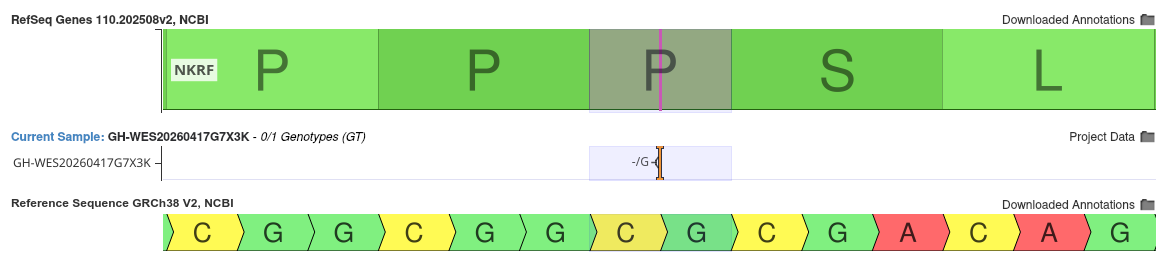
GenomeBrowse also visualizes these transcript-to-genome differences in the transcript plot, making it easier to investigate why a transcript annotation differs from what the genomic sequence alone would suggest. The figure below shows an insertion in the coding region of NKRF that initially appears to result in a frameshift, but the GenomeBrowse plot of the Tx Genome Delta indicates that the inserted base is present in the transcript’s RNA sequence and is therefore synonymous.
ClinGen Allele Frequency Thresholds and BA1 Exceptions
Population frequency is an important component of variant classification, but the appropriate frequency threshold can vary by gene. ClinGen provides gene-specific thresholds for the ACMG/AMP criteria BA1, BS1, and PM2. VSClinical now displays the FAF95 threshold in the Population Frequency panel, helping reviewers evaluate frequency criteria against gene-specific cutoffs rather than relying on a single genome-wide threshold.
ClinGen also provides BA1 Exceptions for variants that exceed the BA1 frequency threshold but have expert-curated evidence supporting pathogenicity. The ACMG Classifier can apply these thresholds and exceptions automatically when the corresponding sources are included in the classifier configuration. VSClinical shows reviewers why a criterion was or was not applied, including when a BA1 exception prevents the frequency criterion from being used.
AlphaGenome
Many variants with potential functional consequences occur outside protein-coding regions. Google DeepMind’s AlphaGenome provides scores that extend across the genome, including intronic and intergenic SNVs, helping laboratories investigate potential effects that conventional coding-focused annotations may miss.
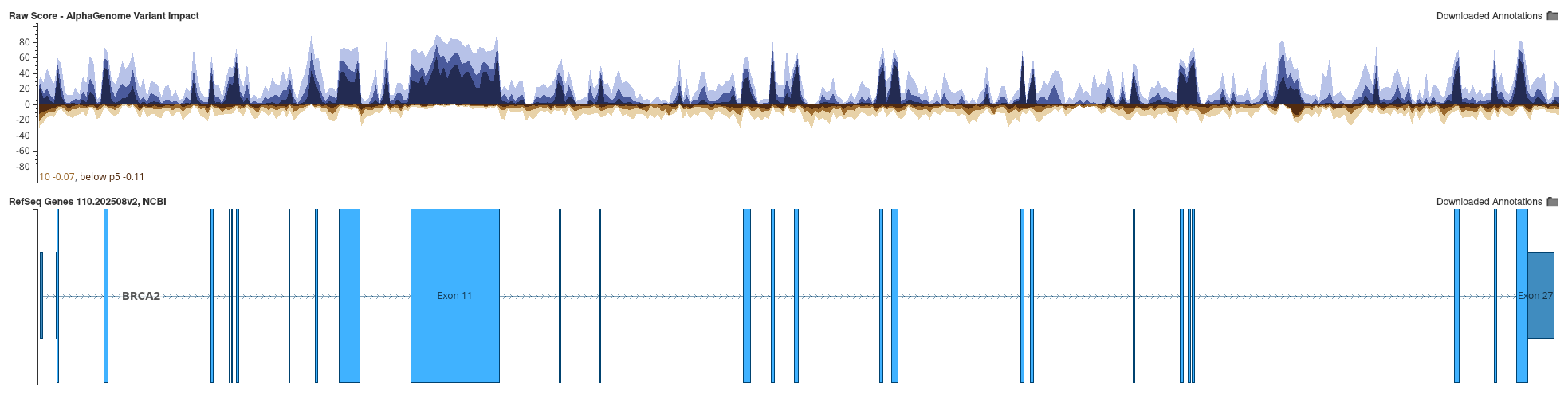
AlphaGenome scores are available in VarSeq as both raw and PHRED-scaled values. When plotted in GenomeBrowse, these annotations help users explore patterns of predicted functional impact across the genome. Spikes in intergenic scores can highlight candidate regulatory regions, while elevated scores within introns can help identify regions where a variant may disrupt splicing. Visualizing these scores alongside genes, transcripts, and variants gives analysts additional context for prioritizing noncoding variants and identifying regions that warrant closer investigation.
PanelApp Australia
Australian Genomics’ national gene-panel resource is now available alongside Genomics England PanelApp. Laboratories can use either resource to build gene lists in VSWarehouse.
MITOMAP MitoTIP
MitoTIP provides pathogenicity scores for mitochondrial tRNA substitutions and single-base deletions, supporting the assessment of mitochondrial variants.
Custom Annotations
The annotation library also supports laboratory-specific and licensed resources. Custom annotations allow laboratories to incorporate their own data while benefiting from the same normalization and versioning approach used for maintained sources.
Previously Interpreted Variant Sources provide trusted prior interpretations along with applicable ACMG criteria which can be incorporated into to the ACMG Classifier to automatically classify variants and override the auto-classifier. Cancer Clinical Evidence Sources contribute clinical evidence to the Oncogenicity Classifier and somatic workflows in VSClinical.
Managing Gene Preferences and Gene Lists in VSWarehouse
Annotation consistency extends beyond external databases. Laboratories also need a reliable way to manage their own transcript selections, gene-level notes, and curated gene lists. VSWarehouse provides a shared catalog for these resources, with versioning and review built into the workflow.
- Gene Preferences provide laboratories with a centralized location for the management of preferred transcripts and other gene-level information. Reviewers can compare transcript options using guidance from MANE, LRG, and ClinVar usage, update the preferred transcript, and publish the changes for use across the lab. Gene-level notes can be edited in VSClinical and made available for clinical reporting.
- Gene Lists can be imported, expanded, or built directly from Genomics England’s PanelApp or PanelApp Australia. When a panel changes or a laboratory updates its list, the revised list can be published as a new version. Previous versions remain available for review, helping laboratories track changes to the gene sets used in their workflows.
Questions From the Webcast
When AI review uses LitVar2, is it limited to those PMIDs or does it search the web?
AI-assisted review draws on several sources, including LitVar2, ClinVar, and dbSNP. It also searches PubMed for direct mentions of the variant of interest, including full-text searches of PubMed Central, to identify additional relevant publications.
How do I know the AI script is not making up citations?
AI review is provided with a defined set of curated citations from trusted sources, supplemented by PubMed and PubMed Central searches. It is instructed to base its interpretation solely on these sources.
For additional transparency, VSClinical aggregates all publications cited in the interpretation into an interactive list. Users can select individual publications to review their abstracts and follow links to the full publications in a web browser. This allows reviewers to verify the cited literature and assess whether the evidence supports the interpretation.
We have an internal database of previously classified variants. Can the ACMG classifier use it automatically?
Yes. Both the ACMG Classifier in VarSeq and VSClinical can be configured to use a custom source containing previously classified variants and their associated classification criteria. When a matching variant is found, the classification and criteria from that source take precedence over the software’s recommended classification and criteria, allowing laboratories to incorporate their established interpretations directly into their workflows.
Conclusion
A reliable genomic annotation library needs broad coverage across evidence domains, precise representation of genomic information, and consistent maintenance of sources as new data becomes available. The Golden Helix Annotation Library brings these capabilities together to support more reliable filtering, classification, and reporting. Ongoing curation keeps the evidence current, while versioning helps laboratories understand which data informed an analysis and reproduce their results when needed. Contact our team if you’re interested in exploring the annotation library with your own data.