
In our post, ACMG Guidelines for Variant Classification: 2015 to v4 – The Golden Helix Blog, we toured the ACMG classifier’s evidence sources, including the new CI-SpliceAI and Missense Pathogenicity annotations. Beyond these new computational sources, one of the biggest changes in the upcoming VarSeq release is how configurable the ACMG Classifier has become. Rather than relying on a fixed set of annotation sources and thresholds, you can tailor many of the classifier’s inputs to match your laboratory’s workflow while still applying the same ACMG framework.
This post walks through the most significant areas of customization: previously interpreted variant sources, internal variant catalogs, multi-record (transcript) selection, and allele frequency thresholds.
Previously Interpreted Variant Sources
One of the most powerful additions is support for Previously Interpreted Variant Sources. These sources contain expert-curated variant interpretations that include not only a classification, but also the evidence criteria and supporting rationale behind that classification.
When the classifier finds a matching interpretation, it adopts the curated ACMG criteria directly rather than recalculating them from scratch. The source of the interpretation is recorded in the new Classification Source field, making it easy to distinguish curated classifications from those generated automatically.
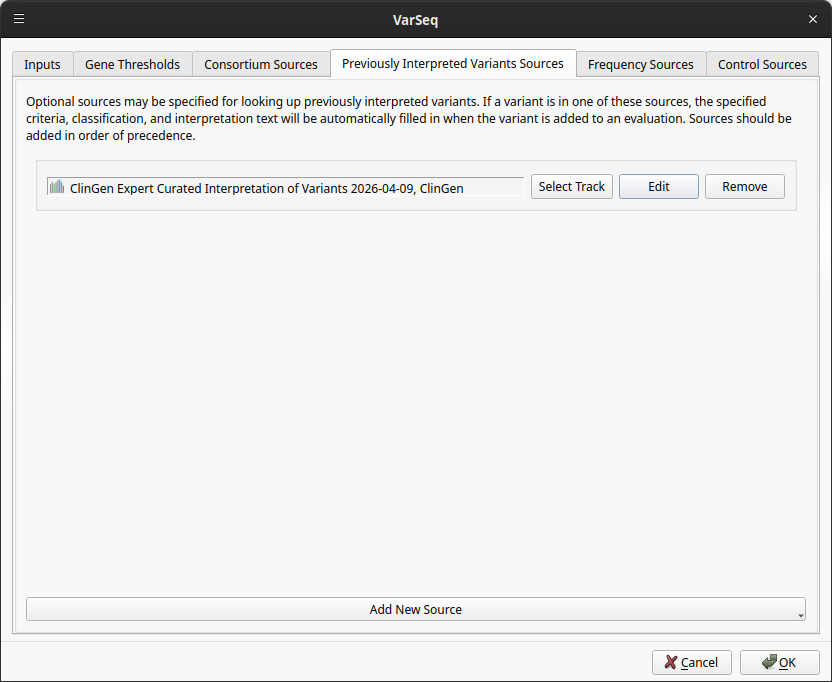
VarSeq configures ClinGen’s Expert Curated Interpretation of Variants as a Previously Interpreted Variant Source by default. Additional previously interpreted variants sources include the IARC TP53 Database and Genomenon Mastermind, provided your VarSeq installation carries the Genomenon license.
Catalog of Classified Germline ACMG Variants
While Previously Interpreted Variant Sources provide external expert knowledge, the Internal Database of Classified Variants captures your laboratory’s own interpretation history.
The classifier reports both an Auto Classification, generated solely from the auto-classifier’s scored ACMG criteria, and a Classification, which incorporates previous interpretations when available. Additional fields, including Previous Classification, Previous Classification Count, and Last Classification Date, provide context for each interpretation.
Maintaining a sample-independent catalog allows classifications to accumulate over time. Once a variant has been reviewed, that assessment becomes immediately available for future samples, helping standardize interpretation across analysts while reducing duplicate effort.
Multi-Record Selection
A single variant site often maps to multiple transcripts, each of which can produce its own classification. Multi-record selection controls which one represents the site. Rather than picking arbitrarily, you can configure the classifier to select the transcript record with the highest value of a chosen metric:
- Score Sum: the sum of all criteria scores
- Score Magnitude: the sum of absolute values of all criteria scores
- Score Pathogenic: sum of pathogenic criteria scores
In practice this surfaces the most clinically significant transcript for a site while keeping the others available. By default the option is off, preserving the full per-transcript list.
Custom Allele Frequency Thresholds and BA1 Exceptions
Population frequency evidence has also become more flexible. Instead of relying on global allele frequency cutoffs, the classifier can use a configurable Allele Frequency Thresholds track that provides gene-specific thresholds for dominant, recessive, and X-linked inheritance models, with ClinGen’s recommended thresholds selected by default.
The classifier also supports a configurable Benign Standalone Exception source. Variants included in this track are exempt from BA1, preventing well-established pathogenic variants with unexpectedly high population frequencies from being classified as benign. This source also defaults to the ClinGen recommendations.
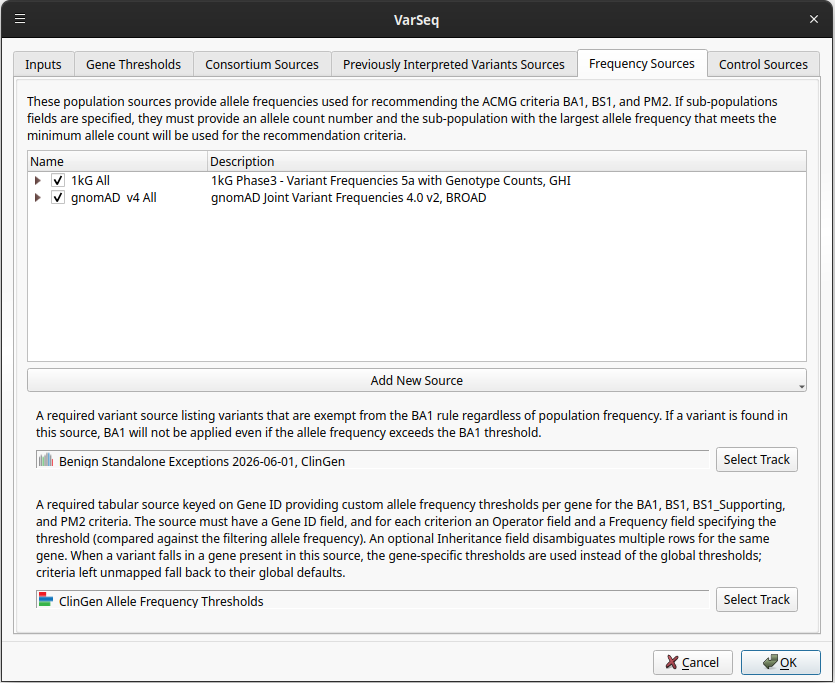
Together, these changes make frequency-based evidence more consistent with current ClinGen recommendations while giving laboratories the flexibility to substitute their own threshold resources if needed.
Conclusion
With the addition of these customization options, the ACMG Classifier is no longer tied to a fixed set of annotation sources or thresholds. Through the incorporation of expert-curated interpretation databases, internal classification catalogs, and gene-specific allele frequency thresholds VarSeq gives you the flexibility to adapt the classifier to your laboratory’s workflow while remaining grounded in the ACMG guidelines.
For a broader look at the classifier’s evidence sources and its new computational annotations, see our companion post, What’s New in the ACMG Classifier. And for the guideline changes that motivated these updates, read Modernized ACMG & Cancer Variant Classification.