
Archer panels have outgrown the SNV-and-indel VCF
Archer panels are no longer just small-variant panels. Over the past year, several of our users have expanded their Archer VARIANTPlex designs into full comprehensive genomic profiling assays. These expanded panels now report structural variants (breakends), copy number changes and genomic signatures: tumor mutational burden (TMB), microsatellite instability (MSI) and homologous recombination deficiency (HRD).
At the same time, more labs are pairing VARIANTPlex DNA libraries with FUSIONPlex RNA libraries from the same specimen. The result is richer, but it also means more files per sample. This post covers what the upgraded Archer output looks like and how VarSeq and VSWarehouse handle each piece: from tertiary analysis and reporting to API access for downstream download.
What’s new in the Archer output
IDT now markets Archer as a modular CGP solution: one DNA panel, one RNA panel, and signatures you add per sample. The VARIANTPlex Complete Solid Tumor panel covers 430 genes for SNVs, indels, CNVs and ITDs, plus TMB and MSI. Version 2 builds HRD into the panel. Version 1 users can add it through the separate VARIANTPlex HRD module. IDT’s scalable CGP page says signatures “can be added for every sample or only for selected samples.”
For a VarSeq user, the practical change is the number of result types per sample:
| Output from Archer Analysis | What it carries | Source library |
| Small-variant VCF | SNVs, indels | VARIANTPlex (DNA) |
| cnvs2.vcf | Gene- and region-level copy number gains and losses | VARIANTPlex (DNA) |
| Breakends VCF | Structural variants as paired breakend (BND) records | VARIANTPlex (DNA) |
| Fusion results | Gene fusions, exon skipping, splice variants | FUSIONPlex (RNA) |
| Signature values | TMB (mut/Mb), MSI status/score, HRD score | VARIANTPlex (DNA) |
A few details from IDT’s marketing are worth repeating to customers:
- TMB is tumor-only. It is calculated without a paired normal, using a somatic/germline classifier, and IDT reports high concordance with WES-based TMB.
- HRD is a new tumor-only algorithm. In an AACR 2025 study using Archer Analysis 7.4, HRD agreed with an orthogonal genomic instability score in 92.3% of samples (24/26) at a threshold of 42 (CGP flyer).
- Archer Analysis is highly tunable. IDT cites more than 80 adjustable settings, including signature thresholds. Labs should document which thresholds they use before mapping results into VarSeq.
Why labs are pairing VARIANTPlex and FUSIONPlex
DNA and RNA answer different questions, and IDT now sells them as one CGP workflow. Its FAQ on combined profiling recommends VARIANTPlex Complete Solid Tumor v2 with FUSIONPlex Pan Solid Tumor v2. Together they cover 511 genes and detect SNVs, indels, CNVs, fusions, exon skipping and splice variants, plus HRD, MSI and TMB.
RNA is still the better evidence for fusions. A DNA breakend shows two genomic positions joined. An RNA fusion read shows the transcript is actually expressed and in frame. When both libraries come from the same specimen, a lab can use the DNA breakend to support the RNA fusion call, or flag a DNA-only rearrangement for review.
IDT’s published configurations:
| Combination | Genes | Reads per sample | Samples per NextSeq 500/550 HO v2.5 kit |
| Pan Solid Tumor v2 (DNA + RNA) | 279 | 40.5M | ~10 |
| Complete Solid Tumor v2 (DNA + RNA) | 511 | 60.5M | ~6 |
Read totals include 12M reads for HRD. Source: IDT CGP flyer.
Tertiary analysis in VarSeq
VarSeq brings every Archer result type into one project per sample, so the analyst reviews DNA and RNA findings side by side and reports them through one VSClinical AMP evaluation.
- Import small variants. The SNV/indel VCF loads as the primary variant table, annotated with population, ClinVar, COSMIC, Genomenon CKB and cancer knowledgebase sources and filtered with the lab’s somatic filter chain.
- Add copy number. cnvs2.vcf imports as a CNV track. Gains and losses are annotated at the gene level and surface in VSClinical alongside small variants in the same gene for evaluation.
- Add structural variants. The breakends VCF imports as a structural variant table. Paired BND records are annotated with the genes at each breakpoint, so an analyst can spot a rearrangement that disrupts a tumor suppressor or supports a fusion.
- Add the FUSIONPlex results. Fusion calls from the RNA library are added to the same sample and evaluated in VSClinical’s fusion workflow for an all-in-one DNA+RNA analysis
- Capture signatures. An evaluation script brings TMB, MSI and HRD values into the VSClinical evaluation, using thresholds the lab sets for high, intermediate and low.
- Report once. VSClinical produces a single report covering small variants, CNVs, SVs, fusions and signatures, with the lab’s own interpretations reused from its knowledgebase.
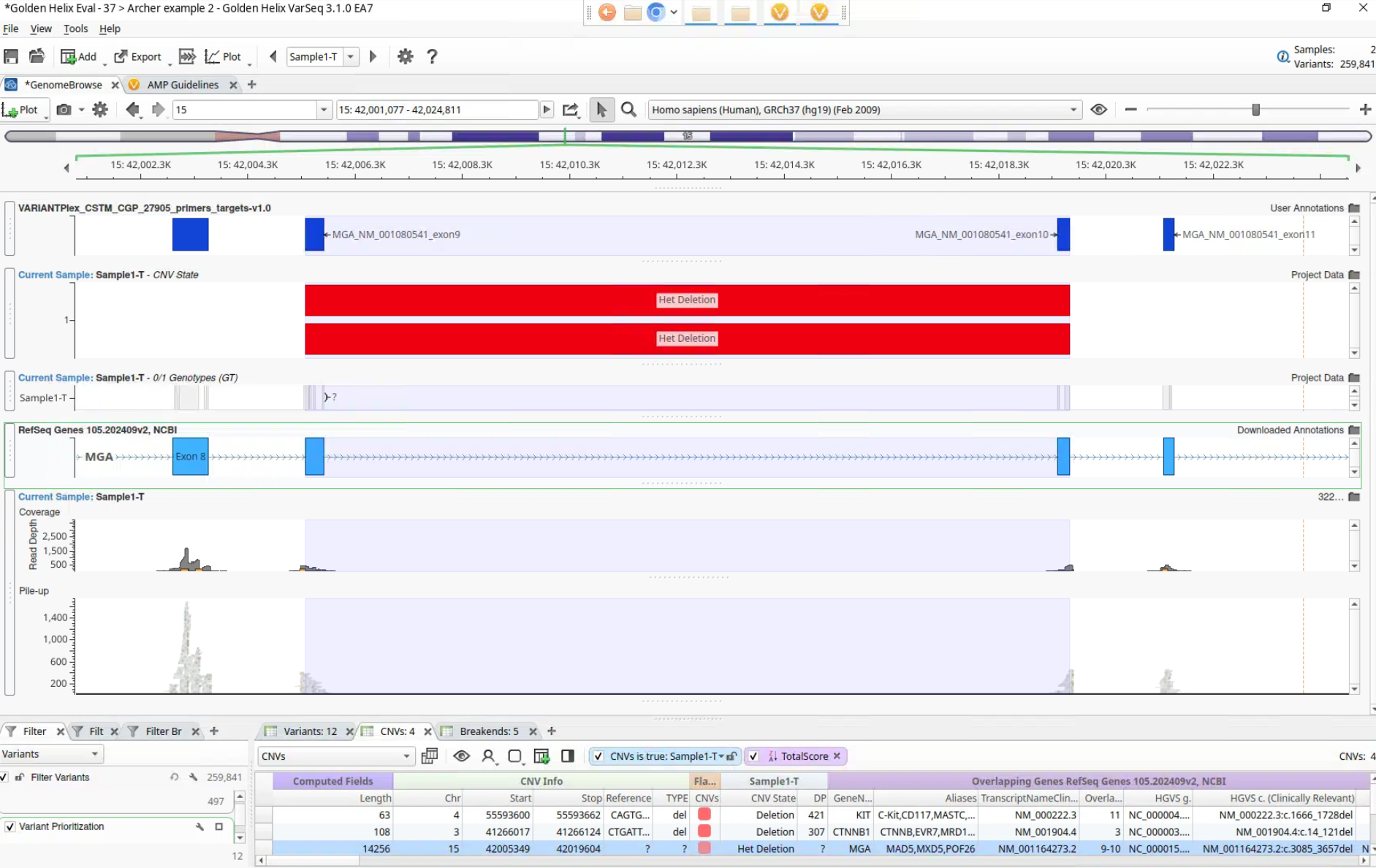
VarSeq’s GenomeBrowse view of an Archer VARIANTPlex sample: a heterozygous deletion across MGA exons 9–10 on chromosome 15, shown with panel targets, coverage, pile-up and the sample’s CNV table.
VarSeq is also extensible beyond its built-in views. Labs can integrate additional visualization tools, such as Circos plots, to see every structural variant in a sample on a single genome-wide view. Interchromosomal rearrangements and fusion partners are easier to spot this way than row by row in a table.
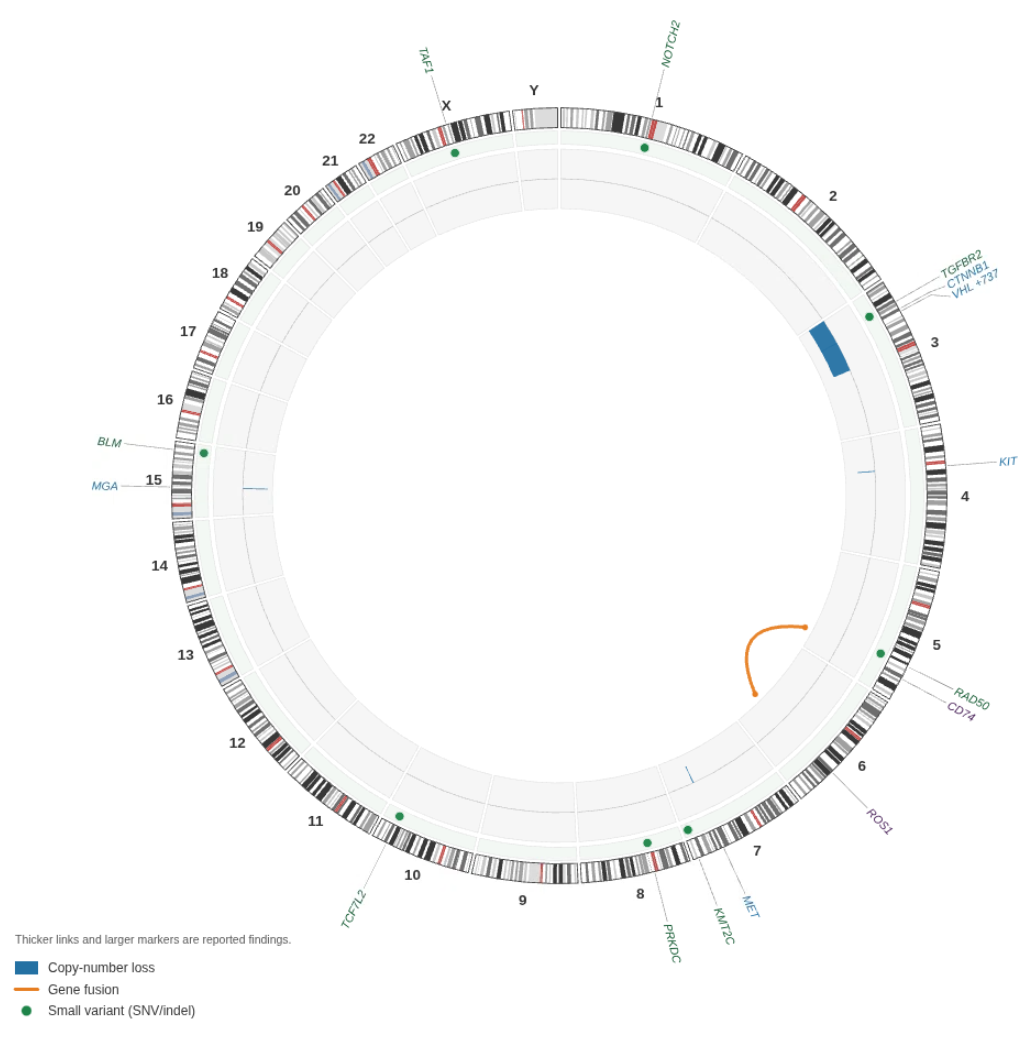
Example Circos plot for a single sample: small variants (green), a copy-number loss on chromosome 3 (blue) and a CD74–ROS1 fusion (orange) on one genome-wide view.
The whole sequence can run unattended. A VSPipeline script watches the Archer Analysis output folder, imports each file type into a project template, and leaves the sample ready for review.
VSWarehouse: one home for DNA, RNA and signatures, with API access
Once a sample is reviewed, VSWarehouse keeps every Archer result type together and makes it queryable across the lab’s whole history. That matters more as panels grow. A lab can ask which samples had both an RNA fusion and a supporting DNA breakend, or pull TMB and HRD scores for every sample in a study.
What customers use it for:
- Cohort queries. Search small variants, CNVs, SVs and fusions across all stored samples, with signature values as sample-level fields.
- Report and metadata access. VSWarehouse contains extensive API documentation, covering patient-level queries, sample and report metadata, and catalog management (Golden Helix integrations page).
- Programmatic download. Saved exports write results to catalogs, and the API lets a LIMS, data lake or research team pull results without logging into the GUI. Reports export as PDF, XML for LIMS handoff, or JSON and multi-tab Excel for analytics.
- End-to-end automation. VSPipeline triggers analysis when new Archer output lands, and structured results flow back to LIMS, and EHR systems through the API.
Bring your expanded Archer panel into VarSeq
As Archer panels grow into full CGP assays, the bottleneck moves from the wet lab to interpretation and data management. VarSeq and VSClinical turn small variants, CNVs, breakends, fusions and signatures into one reviewed report. VSWarehouse keeps them together and opens them to the rest of your systems through its API.
If you are expanding a VARIANTPlex panel, adding FUSIONPlex, or turning on TMB, MSI or HRD, contact our Field Application Scientists. We can help you set up project templates and automation for your Archer output. [[email protected]]
Sources:
- IDT: Archer VARIANTPlex Complete Solid Tumor panel
- IDT: Scalable CGP with Archer NGS assays
- IDT FAQ: Analyzing solid tumor DNA and RNA together
- IDT flyer: Flexible, customizable CGP solutions
- IDT: Genomic signature white paper (HRD, TMB, MSI)
- AACR 2025 Abstract 4615: CGP with VARIANTPlex and FUSIONPlex and Archer’s tumor-only HRD algorithm
- Golden Helix: Customization and integrations (VSWarehouse API, VSPipeline)
