As precision oncology evolves, clinicians and laboratories need tools that can both handle massive genomic datasets and translate those findings into clear, clinically actionable guidance. In our recent webcast, “Simplifying Complex Cancer Data into Actionable Knowledge with Golden Helix CancerKB,” we walked through how Golden Helix CancerKB can take clinical somatic variant analysis to the next level within VSClinical AMP. We primarily focused on how the curation efforts this year were to enhance the diagnostic and prognostic interpretations for the most prominent solid tumors and how this updated the cancer ontologies used within VSClinical AMP.
What Golden Helix CancerKB Provides
CancerKB is designed to save you time, increase lab throughput, and deliver a comprehensive, personalized list of treatments and clinical trials to each patient as efficiently as possible. Together with VSClinical all of the content within CancerKB is applied automatically once a variant is added to an evaluation, including the relevant biomarker interpretations, therapies, and trials. This automation reduces human error and minimizes rework in generating evaluations and reports. In addition, having report-ready written interpretations saves you even more time, as you will spend less time consolidating conflicting write-ups while still including all of the relevant information for cancer genes and biomarkers. We also discussed details of what has changed.
What Changed in Golden Helix CancerKB This Year
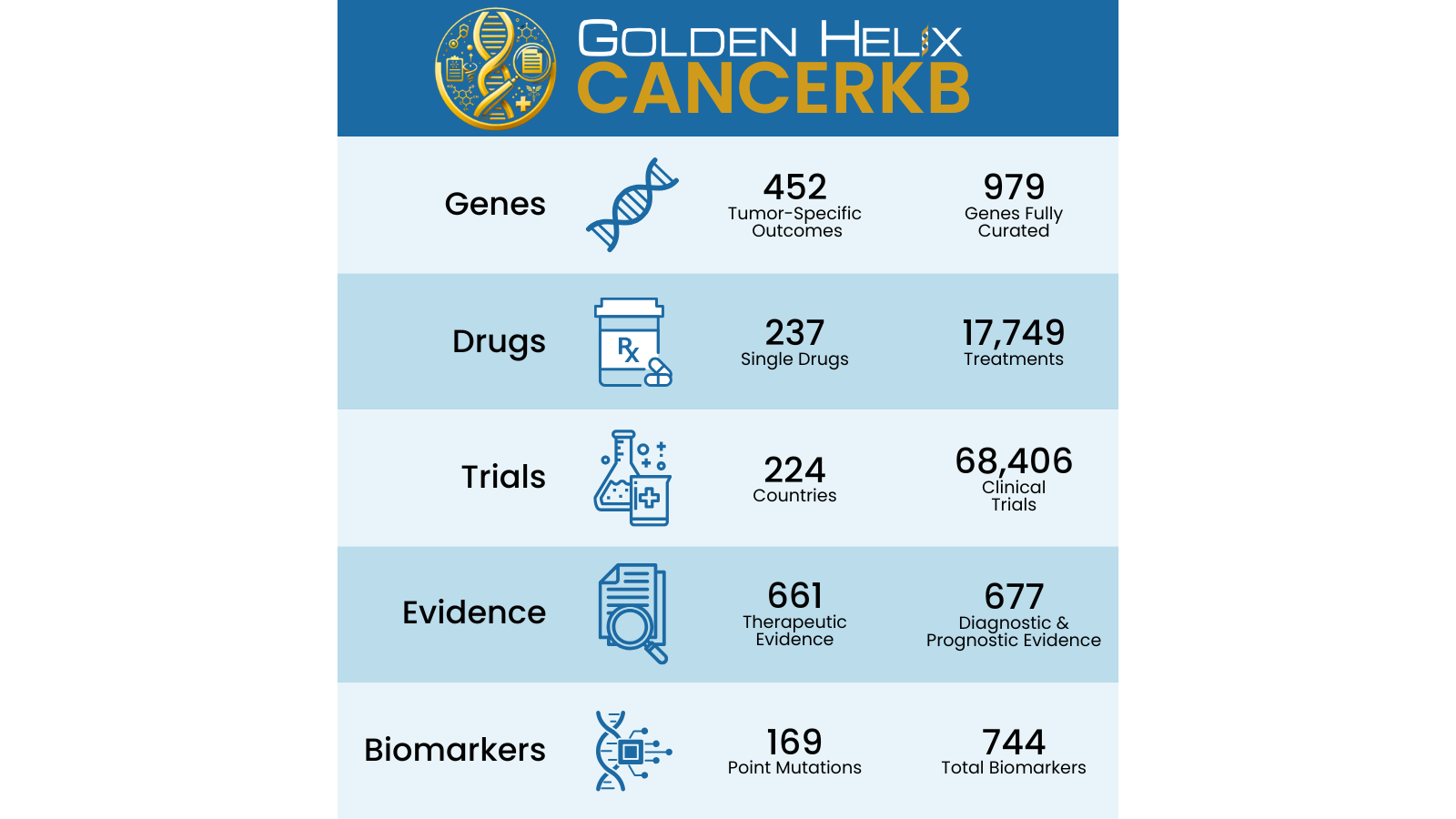
- Nearly 1,000 curated genes
- ~30% increase in diagnostic & prognostic interpretations specific to solid tumors
- Over 100 new biomarker descriptions
- +150 new drug sensitivity interpretations
- 68,000 referenced clinical trials
How Updated Ontologies Improve Real-World Clinical Interpretation
Historically, cancer ontologies were built almost entirely on histology, where the tumor originated and what it looked like under a microscope. For example, breast cancer subtypes were organized under invasive ductal, invasive lobular, papillary, and so on. However, this approach overlooked the most clinically relevant information, including hormone receptor status, HER2 status, and genomic alterations that determine treatment, prognosis, and truly define the disease. Now with updated NCCN and WHO tumor definitions, CancerKB v4 reflects modern tumor classification. This results in cleaner classifications, more relevant evidence, and better alignment with how clinicians actually make treatment decisions.
VSClinical AMP Demo Highlights
- Example 1: We discussed an ERBB2 amplification example in HER2-Positive, HR-Positive Breast Carcinoma to showcase the changes to the cancer ontology tree and show a rounded example of prognostic, diagnostic, and drug sensitivities.
- Example 2: The next example was a KIT exon 11 activating mutation in gastrointestinal stroma tumors. We covered how important the absence or presence of certain KIT and PDGFRa mutations play a big role in drug sensitivities and prognosis for GIST patients.
- Example 3: The final example was looking at prognostic evidence for loss of function POLE and MLH1 variants along with TMB ultra-hypermutated and MSI-high genomic signatures in colorectal adenocarcinoma. From this example we generated a clinical report.
Ultimately, when you apply CancerKB to your clinical workflows, the system delivers automated interpretations grounded in NCCN, WHO, and FDA guidance, provides precise diagnostic language tied to molecular classification, and offers prognostic clarity based on genomic behavior. Therapy options are refined by biomarker specificity, and reporting becomes faster, more consistent, and easier to standardize across cases.
Want to learn more about how CancerKB can elevate your workflows? Contact our team today!