
Heading
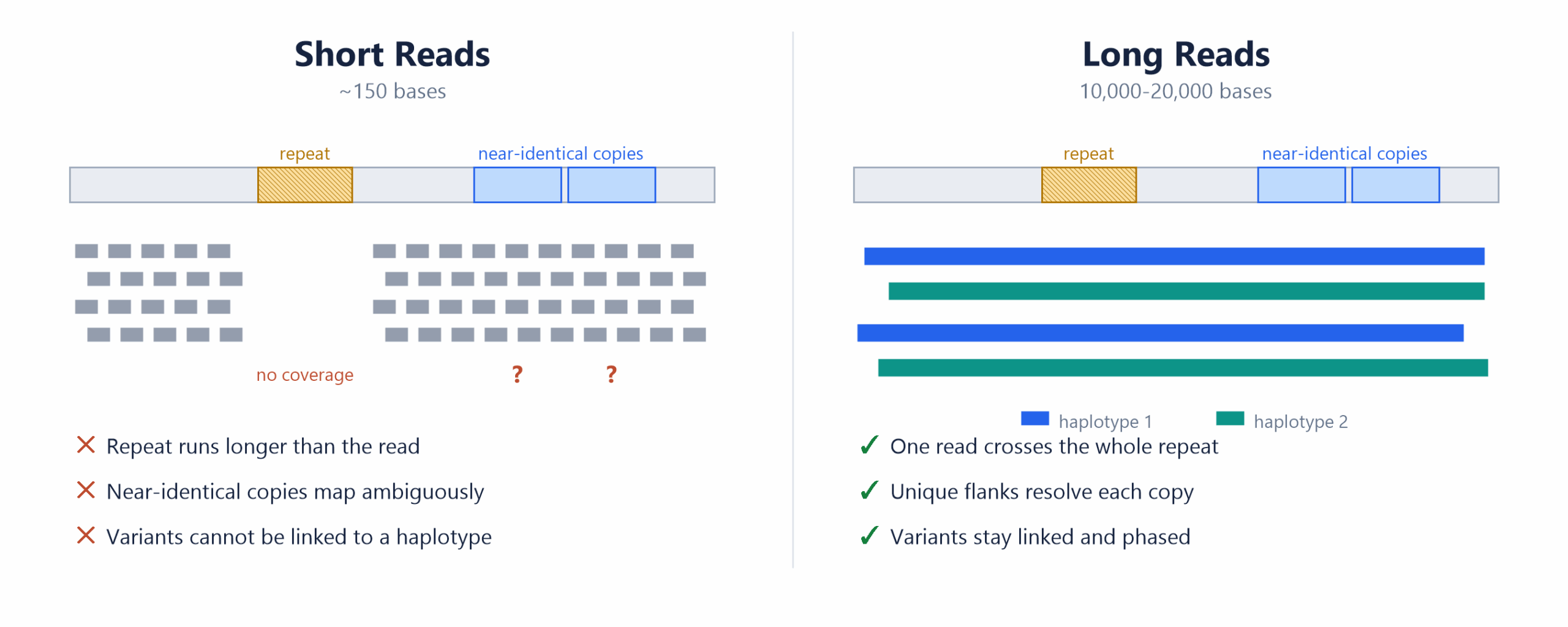
Part 1 of this series covered short-read secondary analysis and the operational infrastructure VSWarehouse brings to it. Long-read sequencing changes what secondary analysis can see in the first place: a repeat expansion counted directly instead of inferred from coverage, near-identical gene copies separated by their unique flanking sequence, and variants that stay linked on their own haplotype (Figure 1). The clinical case for long reads is well established at this point. The operational case is where labs get stuck.
Long-Read Secondary Analysis Is Complicated
Figure 2 is one PacBio HiFi genome moving through secondary analysis in VSWarehouse. It starts simply enough, preparing directories, aligning with pbmm2, merging BAMs, and then it fans out. DeepVariant calls small variants while coverage is profiled alongside it. Paraphase resolves the homologous gene families that short reads cannot separate, and the mitochondrial genome gets a caller of its own. Sawfish calls structural variants and coverage-based CNVs. Those branches merge, pass through TRGT for tandem-repeat genotyping and HiPhase for read-backed phasing, then split again into methylation analysis and pharmacogenomic diplotyping, before converging on PGx upload, a VSBatch file, and a finished VarSeq project.
That is roughly a dozen tools, sixteen steps, and three fan-out-and-merge points. Every tool carries its own container, version, and parameter set. The outputs are genuinely different file types, a phased small-variant VCF, an isolated tandem-repeat VCF, a structural/CNV VCF, methylation tables, and they all have to stay connected to one another for something like a compound heterozygosity call to still mean anything by the time an analyst sees it. Standing this up by hand is not a workflow configuration exercise. It is a bioinformatics project, and it is the reason long-read adoption stalls in labs that are otherwise ready for it.

VSWarehouse Simplifies
None of that assembly is work a lab needs to do. Four things make the difference.
The complete stack comes bundled. The germline stack ships with DeepVariant, Sawfish for structural variants and coverage-based CNVs, TRGT for tandem repeats, Paraphase for homologous gene families, Mitorsaw for the mitochondrial genome, MethBat for methylation, PBStarPhase for pharmacogenomics, and haplotagged BAMs for visualizing phase directly in GenomeBrowse. Sentieon adds a long-read caller and a hybrid long-read/short-read caller for labs running both platforms. The somatic stack carries all of that plus DeepVariant’s somatic caller. PureTarget, the targeted stack, is built for the rare-disease genes that have always been the hardest to call, runs fast because it is scoped to them, and adds report graphics including repeat-length waterfall plots. All of this can be set up in Warehouse to run with one-click so our customers can focus on results instead of weaving a dozen tools together.
The callers are PacBio-proven. PacBio does not release a caller into these pipelines until they have tested and validated it themselves. A lab picking up the bundled stack is not evaluating a set of tools someone wired together; it is picking up the configuration the platform vendor stands behind. Nothing is locked down either: the task and workflow definitions are open, so a lab that needs a different tool version or parameter can change it and keep the rest of the chain intact.
It is free, and it is one download. The pipelines are freely available on GitHub and pull directly into VSWarehouse. No per-pipeline licensing, no manual container wrangling, no dependency resolution. Everything in the stack is free software with the single exception of Sentieon.
It is already connected to tertiary analysis. This is the part that is easy to underrate. The workflow does not stop at a VCF; it ends at a VarSeq project or a report. FASTQ or uBAM goes in, and clinically reviewable output comes out, with no manual import step where a tandem-repeat file lands in the wrong table or phasing information gets dropped on the way.
Conclusion
Long-read sequencing resolves what short reads structurally cannot, and the callers to do it are mature. What has been missing is not capability but assembly: a dozen validated tools, chained correctly, versioned reproducibly, and delivered into a form a clinical analyst can immediately review. VSWarehouse ships that chain pre-built, PacBio-validated, free, and already connected to tertiary analysis. The lab’s job goes back to interpreting results rather than building the machinery that produces them.