Oxford Nanopore Technologies
Tertiary analysis for long-read sequencing: nanopore SNVs, indels, structural variants, copy-number changes, and 5mC methylation calls in a single ACMG-driven interpretation workflow.

Nanopore variants in your VarSeq tertiary workflow
Golden Helix and Oxford Nanopore Technologies (ONT) collaborate to close the gap between nanopore secondary analysis and the ACMG-guided clinical reporting your lab signs out. ONT's PromethION and MinION platforms produce long reads, structural-variant calls, and native 5mC methylation signals that short-read panels do not generate. VarSeq supports reading all of these outputs into your tertiary workflow.
The integration covers the full output of EPI2ME workflows: SNV and indel VCFs, structural-variant VCFs, low-pass copy-number calls, and BEDMethyl methylation tracks. Each variant class lands in VarSeq under analysis tuned to its class: SNV and indel filtering with ACMG/AMP classification in VSClinical, ClinGen/ACMG-2019 dosage scoring for CNVs and SVs, and methylation-aware filters for the BEDMethyl tracks.
For hereditary cancer testing, your variant scientist can call out a CHEK2 missense, a complex BRCA1 rearrangement, and a constitutional MLH1 promoter methylation event from the same VarSeq project.
Hereditary Cancer (HerCan) Panel Support
ONT's Hereditary Cancer Panel uses adaptive sampling on a single PromethION flow cell to enrich for 258 cancer-predisposition genes. One library prep captures variant classes that historically required three separate assays. Your VarSeq project surfaces all of them side by side.
SNVs & Indels
Clair3-derived small-variant calls with R10.4.1 chemistry, including phased haplotypes from long reads.
Structural Variants
Large insertions, inversions, translocations, and complex rearrangements that fall through short-read alignment.
Copy Number
Whole-exon and whole-gene deletions and duplications resolved across the full panel footprint.
Methylation
Native 5mC calls from the same reads, no bisulfite conversion. Surfaces constitutional epimutations such as MLH1 promoter hypermethylation.
Why this matters for hereditary cancer
Long reads disambiguate clinically actionable variants from their pseudogene paralogs, a historical source of false negatives and false positives in Lynch-syndrome and breast-cancer panels.
Large BRCA1/BRCA2 rearrangements, mobile-element insertions, and breakpoint-spanning structural variants are called directly, without orthogonal MLPA confirmation.
Constitutional methylation events, such as MLH1 or BRCA1 promoter silencing, are detected from the same reads, without a separate methylation assay.
Annotate. Classify. Interpret.
VarSeq reads the EPI2ME wf-hereditary-cancer outputs directly: VCFs for small variants and SVs, BAMs for visualization, BEDMethyl for methylation. From there, your team runs the same ACMG-driven workflow your lab already uses for short-read panels.
Unified annotation across variant classes
- ›Population frequencies from gnomAD v4, transcript impact from RefSeq + Ensembl, and curated assertions from ClinVar and OMIM.
- ›Structural variants intersected against gene exons, regulatory regions, and known pathogenic CNV catalogs.
- ›Methylation calls overlaid onto promoter and CpG-island tracks for genes on the HerCan panel.
ACMG/AMP classification with VSClinical
- ›VSClinical pre-evaluates the 28 ACMG criteria for each variant (pathogenic, likely pathogenic, VUS, likely benign, benign), with the full evidence trail attached.
- ›Gene-specific guidance applied per gene, including ClinGen VCEP rules where the panel publishes them.
- ›SVs and CNVs classified per the ACMG/ClinGen 2019 framework, with point-based scoring.
Clinical sign-off and reporting
- ›One report combining SNVs, SVs, CNVs, and constitutional methylation findings, with no manual reconciliation between assays.
- ›Customizable report templates aligned to lab-developed test (LDT) and research use requirements.
- ›Audit-ready evidence trail: each ACMG criterion called, each reference cited, each reviewer change captured.
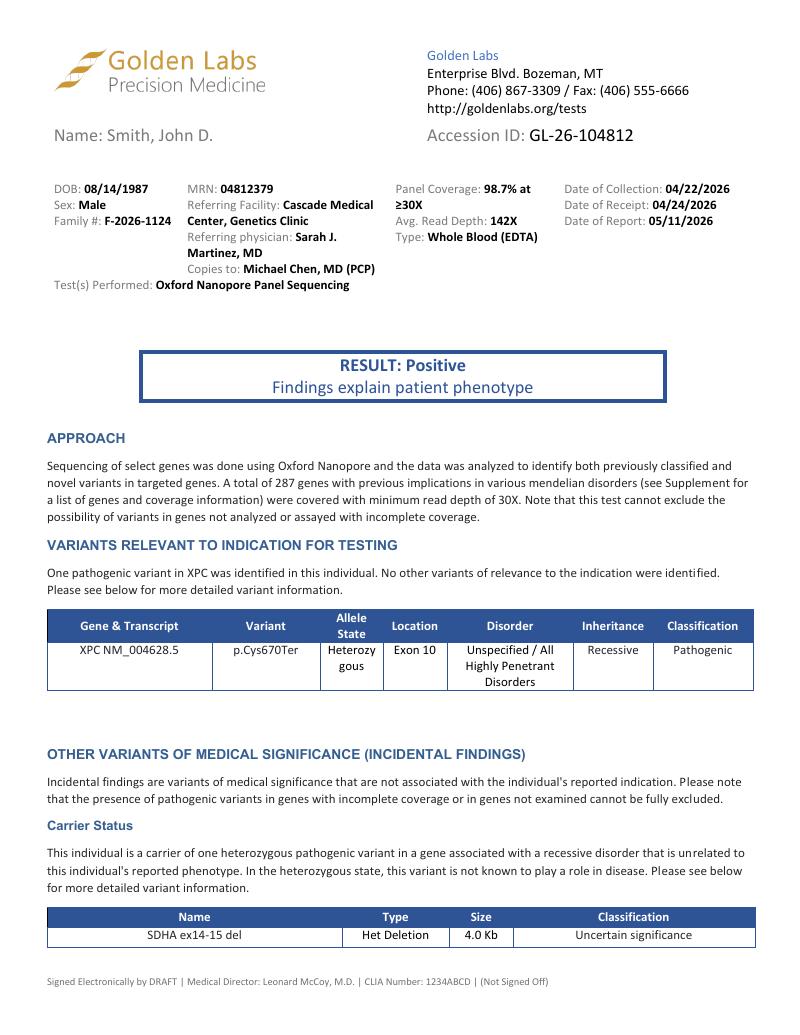
See a complete example report
Click the preview to open a sample VarSeq clinical report generated from the ONT HerCan panel. It includes the variant tables, ACMG evidence with versioned annotations and cited sources, methylation findings, and the full sign-off page.
Download PDFNote: the example report can be customized to match your lab's branding, content preferences, and layout. This is a sample only and should not be used for clinical decision-making.
Reference Resources
wf-hereditary-cancer reference dataset
Technical specifications, reference data, and benchmarking from Oxford Nanopore for the HerCan panel workflow.
Comprehensive genomic & epigenomic profiling
Oxford Nanopore application note covering panel design, methylation profiling, and detection of variants missed by short-read methods.
Run ONT HerCan Through ACMG Reporting
See your lab take Oxford Nanopore HerCan panel output through annotation, ACMG classification, and a sign-off-ready report in VarSeq.